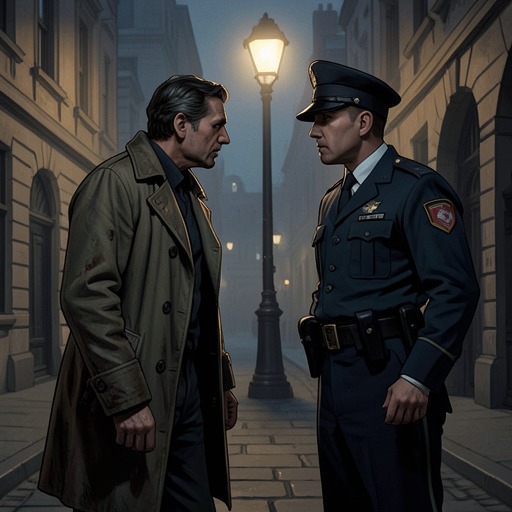
Redrick Schuhart's arrest at the Borscht
Roadside PicnicRedrick Schuhart’s arrest at the Borscht converts a routine-looking black-market exchange into a controlled ambush. Captain Quarterblad’s presence, the search of Redrick’s briefcase, and the display of contraband make the bar a temporary police chamber: the Zone’s illicit goods are exposed, while Redrick’s refusal to pick up the money turns the seizure into a contest over dignity as well as control.
The setup and its institutional background
The arrest belongs to a wider system of passes, checkpoints, and surveillance around the Zone. Earlier, Redrick is ordered to appear before Chief of Security Captain Herzog, an instruction delivered without ceremony after an official has inspected his pass. In another crossing, he and his companion hand their passes to a lieutenant before entering the Zone. These procedures frame movement as something that authorities can authorize, observe, and interrupt; the Borscht raid carries that administrative power into the black market.
The Zone itself remains visible from protected space but is not made ordinary by that proximity. Looking through thick, leaded windows, Redrick sees it close enough to seem touchable. Beyond the glass lies an abandoned industrial town, with rails, furnaces, and an open garage, but no living or dead inhabitants. The contrast between the empty landscape and the city’s systems for managing access gives the arrest a particular pressure: the border is not simply a line around danger, but a structure shaping work, trade, and exposure to risk.
The ambush in the back room
The immediate trap begins with a blunt question from Ernest: he asks whether Redrick has brought it. When Redrick asks what he means, Ernest proposes that they talk. The apparently private conversation moves to a back room, where Ernest steps aside and sits by the wall. Captain Quarterblad is already standing at the table, his face yellow and angry, and a huge UN trooper appears from the left. The arrangement leaves Redrick facing a prepared search rather than a negotiation.
The trooper frisks Redrick and pauses at his right pocket, where he finds brass knuckles. He then directs Redrick toward Quarterblad’s table, and Redrick sets his briefcase down in front of the captain. The room is secured against escape: two porters smirk in the doorway, there is no other door, and the window is barred from the outside. The operation thus combines military force, confinement, and the participation of people already inside the establishment; the bar’s back room has become an enclosure in which the authorities control both the body and the goods.
Contraband, money, and humiliation
Quarterblad rummages through the briefcase with both hands, taking out Redrick’s haul and laying it on the table. The inventory begins with two small empties and nine batteries, followed by black sprays of different sizes. By making the objects visible one by one, the search turns hidden traffic from the Zone into an exposed collection that the authorities can inspect and claim.
The confrontation sharpens when Redrick pulls out a pack of bills and flings it onto the table, scattering the money. Quarterblad asks whether there is more. Redrick shouts an insult and throws a second pack onto the floor, then tells the captain he hopes he chokes on it. Quarterblad answers calmly that Redrick must pick it up. Redrick refuses, putting his hands behind his back. The money’s movement—from pocket to table to floor—makes the struggle over authority concrete: the captain can order, but Redrick can still withhold the small act of submission that would complete the humiliation.
Aftermath and significance
The arrest sits within a pattern of direct encounters between Redrick and Quarterblad. When the captain confronts him elsewhere, Redrick greets him as an old friend and mocks his ill-looking appearance. At the Borscht, that familiarity offers no protection; Quarterblad is now the officer directing the search, and Redrick’s defiance takes place inside a room arranged to prevent escape. The contrast shows how their personal hostility is backed by institutional force.
The episode also connects the raid to Redrick’s later efforts to evade capture. After a separate encounter in which he escapes Quarterblad, he approaches his own garage from beside a radio and electronics store and waits while workers load television sets into a van, keeping himself among the lilac bushes. That later concealment underscores the practical consequences of the arrest and pursuit: ordinary streets, workplaces, and even the approach to a private garage become spaces where Redrick must manage visibility and risk.
At the Borscht, official power is neither abstract nor cleanly separated from everyday life. It arrives through a question about a delivery, a hidden trooper, barred windows, a searched pocket, and money scattered under an order. Redrick is physically contained, but his refusal to pick up the bills preserves a limited, costly gesture of resistance. The scene’s decisive shift is from the presumed freedom of a meeting to the enforced exposure of both person and contraband.